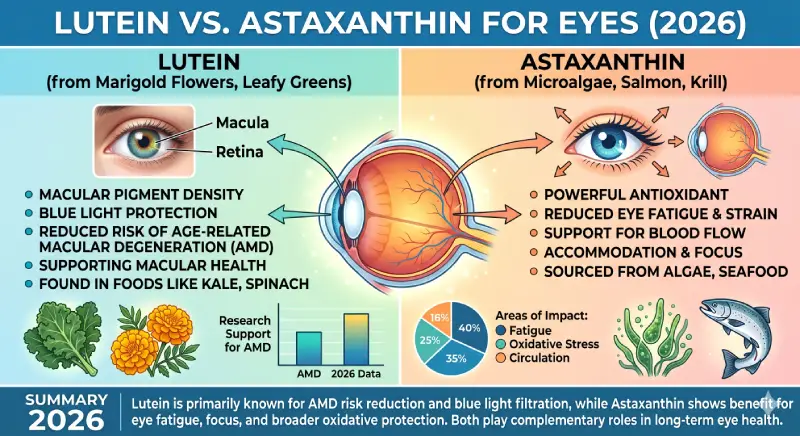
Lutein and astaxanthin are not competitors — they are partners. Lutein (with zeaxanthin) physically filters blue light and builds the macular pigment that prevents AMD. Astaxanthin crosses the blood-retinal barrier to quench oxidative stress inside retinal cells and provides the most direct relief for screen-related eye fatigue. They work at different anatomical levels and through different mechanisms. For comprehensive eye protection, both are needed. But if you can only take one right now, the answer depends on your primary concern — which this guide will clarify.
Both lutein and astaxanthin are carotenoids with significant clinical evidence for eye health. Both appear in premium eye supplements. Both are frequently recommended by eye care professionals. Yet they are profoundly different in how they work, where they act in the eye, and what conditions they are best suited to address. This comparison settles the question with science — not marketing copy.
Meet the Contestants
A yellow carotenoid found in dark leafy greens and egg yolks. Accumulates selectively in the macula and lens. Forms the macular pigment — the eye's only intrinsic blue light filter. The primary carotenoid in the AREDS2 formula. Requires 10 mg/day and 3–6 months to build protective macular pigment levels. The long-game nutrient for AMD prevention.
A red-pink carotenoid from microalgae with a unique molecular structure that spans entire cell membranes. Crosses the blood-retinal barrier for direct access to retinal cells. The world's most powerful antioxidant by weight. Works inside cells rather than filtering light optically. The fast-acting nutrient for screen fatigue relief and cellular-level retinal protection.
How Each Works — Fundamental Mechanisms
Lutein: The Optical Filter
Lutein's primary mechanism is physical light filtration. It absorbs blue-violet wavelengths (400–490 nm) directly within the macular pigment layer — before they reach the underlying photoreceptors and retinal pigment epithelium (RPE). Think of it as a pair of built-in yellow sunglasses inside your retina. The denser the macular pigment (measured as MPOD), the more blue light is absorbed before it can generate reactive oxygen species in the photoreceptors.
Lutein also functions as a lipid-soluble antioxidant within the photoreceptor membranes, providing a secondary layer of protection by neutralising ROS that the pigment filter does not catch. Its antioxidant capacity, while meaningful, is several orders of magnitude lower than astaxanthin's.
Astaxanthin: The Cellular Antioxidant
Astaxanthin's primary mechanism is cellular antioxidant protection — specifically within the retinal cells themselves. Its elongated molecule spans the entire lipid bilayer of cell membranes, providing simultaneous antioxidant protection on both the cytoplasmic and extracellular faces of the membrane. No other natural antioxidant does this. Crucially, astaxanthin crosses the blood-retinal barrier — meaning it reaches retinal tissue via the bloodstream, acting from within rather than through optical filtration.
Astaxanthin also protects retinal capillary blood flow — the microcirculation that delivers oxygen and nutrients to the most metabolically active tissue in the body. Improved retinal perfusion is the primary mechanism behind its documented reduction in eye fatigue and accommodative dysfunction in screen workers.
Lutein works before light hits the photoreceptors — it filters incoming blue light at the optical level in the macular pigment layer. Astaxanthin works after light has been absorbed — it neutralises the reactive oxygen species generated inside retinal cells as a consequence of photon absorption. Both protection layers are necessary. Neither substitutes for the other.
7 Head-to-Head Rounds
Macular Degeneration Prevention
Lutein is validated by the AREDS2 trial (4,203 participants, 5 years) showing up to 26% AMD progression reduction. No other supplement in history has this scale of direct AMD clinical evidence. Astaxanthin contributes antioxidant protection relevant to AMD but lacks comparable RCT data. Lutein wins decisively.
Screen Worker Eye Fatigue
Multiple Japanese RCTs in VDT workers confirm astaxanthin (6–12 mg/day) significantly reduces eye fatigue, blurred vision and accommodative lag within 4 weeks. Lutein improves contrast sensitivity but lacks comparable direct evidence for fatigue relief. Astaxanthin wins clearly.
Blue Light Physical Protection
Lutein absorbs blue-violet wavelengths (400–490 nm) directly in the macular pigment — physically preventing light from reaching photoreceptors. Astaxanthin does not filter light; it neutralises downstream damage. For the filtration mechanism specifically, lutein is unmatched. Lutein wins.
Cellular Antioxidant Capacity
Astaxanthin's antioxidant capacity is estimated at 6,000× vitamin C and 550× vitamin E. It protects both sides of the cell membrane simultaneously — a property lutein cannot claim. For neutralising ROS inside retinal cells, astaxanthin is in a different class. Astaxanthin wins decisively.
Dry Eye & Ocular Surface
Neither lutein nor astaxanthin is the primary nutrient for dry eye — omega-3 fatty acids are. However, both contribute: astaxanthin reduces ocular surface inflammation, while lutein's anti-inflammatory properties in the conjunctival tissue provide some benefit. Both are secondary players here. Tie — both help moderately.
Volume of Clinical Evidence
Lutein appears in 80+ published clinical studies, including the AREDS2 trial — the largest nutritional RCT in ophthalmology history. Astaxanthin has strong evidence (particularly Japanese VDT trials) but a significantly smaller total study volume. For pure evidence quantity, lutein leads. Lutein wins.
Time to Noticeable Benefit
Astaxanthin shows measurable improvements in eye fatigue and retinal blood flow within 4 weeks. Lutein requires 3–6 months to produce measurable MPOD increases — its benefits accumulate slowly. For someone wanting faster symptom relief, astaxanthin responds on a dramatically shorter timescale. Astaxanthin wins clearly.
Master Comparison Table
| Category | Lutein (+Zeaxanthin) | Astaxanthin | Edge |
|---|---|---|---|
| Primary Mechanism | Optical blue light filtration in macular pigment | Cellular antioxidant; blood-retinal barrier crossing | Different — complementary |
| AMD Prevention | AREDS2 validated — 26% risk reduction | Contributes via antioxidant pathway — no direct AMD RCT | Lutein Wins |
| Screen/Eye Fatigue | Improves contrast sensitivity; indirect benefit | Multiple RCTs; significant fatigue reduction in 4 weeks | Astaxanthin Wins |
| Blue Light Filtration | Physically absorbs 400–490 nm in macular pigment | Does not filter light — neutralises downstream ROS | Lutein Wins |
| Antioxidant Power | Meaningful — but limited membrane coverage | 6,000× vitamin C; spans full cell membrane bilayer | Astaxanthin Wins |
| Speed of Action | 3–6 months for MPOD increase | 4 weeks for fatigue relief | Astaxanthin Wins |
| Dry Eye | Modest — some anti-inflammatory benefit | Modest — reduces ocular surface inflammation | Tie ~ |
| Clinical Evidence Volume | 80+ RCTs; AREDS2 gold standard | Strong but smaller evidence base | Lutein Wins |
| Blood-Retinal Barrier | Does not cross — acts at macular surface | Crosses freely — acts inside retinal cells | Astaxanthin Wins |
| Retinal Microcirculation | Indirect — via overall retinal health | Directly protects retinal capillary blood flow | Astaxanthin Wins |
| Typical Daily Dose | 10 mg (with 2 mg zeaxanthin) | 6–12 mg from H. pluvialis | Both reasonable ~ |
Round score: Lutein wins 4 · Astaxanthin wins 4 · Ties 3 — they are genuinely complementary, not interchangeable.
Why You Probably Need Both
The framing of this comparison as a battle with a single winner is, ultimately, artificial — because the science points clearly toward using both together. Here is why:
Lutein filters blue light before it reaches photoreceptors — it prevents a proportion of the incoming photonic damage. But it cannot filter all of it. The photons that pass through the macular pigment still generate ROS in retinal cells. That is exactly where astaxanthin picks up — neutralising ROS inside the very cells that lutein could not fully protect.
Astaxanthin relieves eye fatigue and protects retinal blood flow — benefits lutein does not provide. But astaxanthin does not build macular pigment, does not filter incoming light, and does not replicate the AREDS2 AMD risk reduction evidence that lutein and zeaxanthin have accumulated over decades of research.
They protect against the same ultimate outcome — retinal oxidative damage and AMD progression — through entirely different pathways. Using both is not redundancy. It is complete coverage.
Lutein + Astaxanthin: What Each Covers
When combined, these two carotenoids — ideally with zeaxanthin and omega-3 — provide multi-layer protection that neither offers alone:
Which to Prioritise Based on Your Situation
If budget or availability means you must choose one to start with, here is the decision framework:
Start with Lutein if you are...
- Over 45 with AMD risk factors (family history, genetics, smoking history)
- Diagnosed with early or intermediate AMD
- Following an ophthalmologist-recommended AREDS2 protocol
- Primarily focused on long-term prevention over acute symptoms
- Not experiencing significant screen-related fatigue
Start with Astaxanthin if you are...
- Under 45, spending 6+ hours daily on screens
- Experiencing eye fatigue, blurred vision or headaches after screen use
- Wanting faster, noticeable symptom relief
- Already taking a lutein/zeaxanthin formula and want to expand protection
- A developer, designer or other screen-intensive professional
Several premium eye formulas now combine lutein, zeaxanthin and astaxanthin in a single daily dose — including iGenics and Eagle Eye X20 reviewed in this hub. Taking a combined formula is more convenient and often more cost-effective than managing two separate supplements, and ensures you never accidentally skip one component.
See our ranked reviews of the best combined lutein + astaxanthin formulas for 2026.
Ready to Build Your Complete Eye Protection Stack?
See our independently ranked reviews of the best lutein, zeaxanthin and astaxanthin supplements — individually and in complete formulas.
Frequently Asked Questions
One Article Left in the Hub
Complete the Vision Health Hub: